
Both VSI and HSI crushers fall under the same broad category, impact crushing, but they work in genuinely different ways and suit different jobs. Confusing the two, or assuming either will do, is a common and costly mistake when specifying a crushing circuit.
The short answer: a VSI (Vertical Shaft Impactor) uses a vertical rotor to fling material outward at high speed against an anvil ring or a self-forming bed of rock, using the material’s own impact to do much of the crushing. An HSI (Horizontal Shaft Impactor) uses a horizontal rotor fitted with blow bars that strike the material directly. VSI is typically the choice for a later-stage finishing crusher where cubical shape and manufactured sand quality matter most. HSI is the more flexible workhorse, suited to primary or secondary crushing and particularly effective on recycling and demolition material. Here’s the detail behind that.
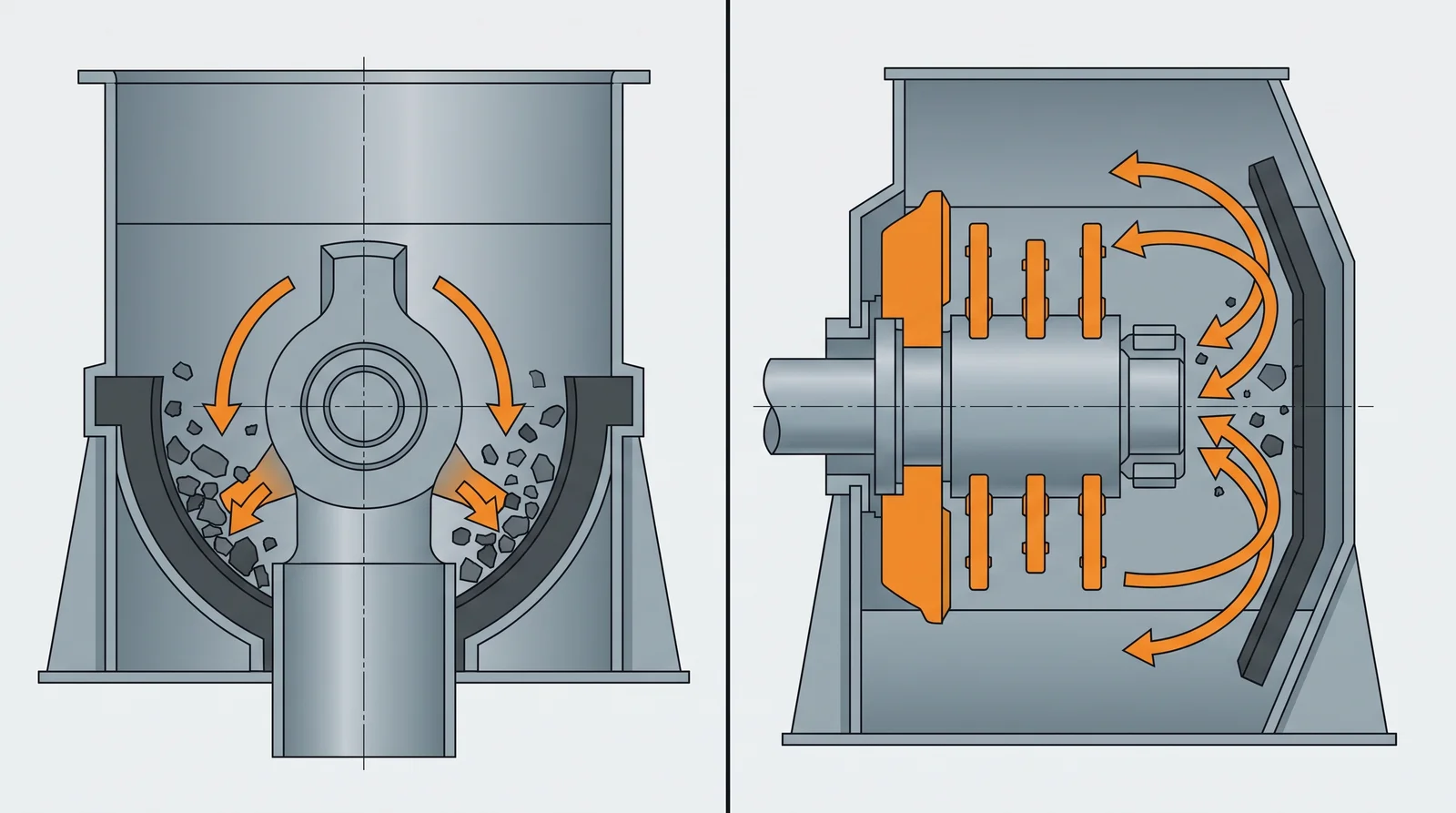
How a VSI crusher actually works
A VSI crusher feeds material through the centre of a high-speed vertical rotor. Centrifugal force accelerates the material outward until it’s thrown against either a fixed anvil ring or, in a rock-on-rock configuration, against a self-forming bed of accumulated rock built up around the rotor’s edge. The material essentially crushes itself and other particles on impact, an autogenous or semi-autogenous process.
This principle has a genuine, distinctive advantage: because the rock does much of the crushing work rather than a wear part striking it directly, a properly configured VSI can process abrasive material with meaningfully lower wear costs than a crusher relying on direct impact. VSI crushers are also typically positioned as a tertiary or quaternary stage in a circuit, downstream of a primary or secondary crusher that has already reduced the material to a manageable feed size, since VSI feed openings are more limited than a primary crusher’s.
How an HSI crusher does it differently
An HSI crusher uses a horizontal rotor fitted with blow bars or hammers. As the rotor spins at high speed, the blow bars strike the material directly, and the resulting fragments are then projected against aprons or breaker plates lining the chamber, adding a second round of impact and further reduction.
This direct-strike mechanism makes HSI genuinely versatile. It functions effectively as either a primary or secondary crusher, handles a wide range of material from soft limestone through to medium-hard stone, and is particularly effective on concrete and asphalt recycling. The striking action efficiently liberates embedded rebar from reinforced concrete, which is exactly why HSI crushers are a common choice in Construction and Demolition (C&D) recycling applications.
The differences that actually determine your choice
Crushing stage. HSI is flexible enough to work as a primary or secondary crusher on raw feed. VSI is typically a later-stage finishing crusher, most effective once a primary or secondary stage has already reduced the material to a suitable feed size.
Output shape. This is VSI’s defining strength. The rock-on-rock crushing principle produces a consistently cubical product with very high shape quality, which is exactly why VSI is the standard choice for manufactured sand and premium aggregate destined for concrete or asphalt applications where particle shape affects the strength of the finished product. HSI produces a reasonably good shape too, but tends toward more elongated or flaky particles and a higher proportion of fines than a well-run VSI.
Throughput capacity. Large primary HSI units can handle very high tonnage. VSI throughput is inherently more limited by rotor size, motor capacity and the physics of the centrifugal force involved, which is part of why VSI tends to sit later in a circuit rather than at the front of it.
Wear costs on abrasive material. A properly configured VSI, particularly in a rock-on-rock chamber, can process abrasive material with lower wear costs than a direct-impact machine, since the rock absorbs much of the punishment rather than a wear part. That said, VSI isn’t automatically the answer for very hard or highly abrasive feed without the right configuration, it’s a genuine strength, not an unconditional one.
Recycling and demolition material. HSI’s direct striking action is particularly effective at liberating rebar from reinforced concrete, making it the more common choice for C&D recycling streams specifically.

So when should you actually choose a VSI over an HSI?
If your priority is the most consistently cubical product, manufactured sand or premium aggregate for concrete or asphalt, and you already have a primary or secondary stage handling the initial reduction, a VSI is generally the right call for that finishing stage.
If you need a flexible crusher that can handle raw feed directly, work as either a primary or secondary stage, or process demolition and recycling material that includes embedded rebar, an HSI is generally the better fit.
Many well-designed circuits actually use both, an HSI (or a jaw crusher) handling the primary reduction, and a VSI finishing the product to the shape and specification the application demands. We’ve covered the primary crushing side of this in more detail in our guide to jaw crusher vs impact crusher selection, which is worth reading alongside this one if you’re specifying a full circuit rather than a single machine.
Where Vastum fits into this
At Vastum Engineering, our impact crusher range genuinely spans both types, so we can help specify whichever configuration actually fits your material and application rather than defaulting to one.
Our vertical shaft (VSI) models are available up to 100 TPH and up to 280 TPH. Our horizontal shaft (HSI) models span up to 35 TPH, up to 50 TPH, and up to 150 TPH. Whether your application is quarrying and mining or construction and demolition recycling, that’s exactly the kind of specification conversation our team works through with clients.
Frequently asked questions
What is a VSI crusher?
A VSI (Vertical Shaft Impactor) crusher uses a high-speed vertical rotor to fling material outward against an anvil ring or a self-forming bed of rock, crushing it largely through the impact of the material against itself, an autogenous or semi-autogenous process. VSI crushers are known for producing a highly consistent, cubical product and are typically used as a later-stage finishing crusher, particularly for manufactured sand and premium aggregate.
What is the difference between a VSI and an HSI crusher?
A VSI uses a vertical rotor and centrifugal force to throw material against an anvil ring or rock bed, producing a highly cubical product and typically running as a tertiary or quaternary stage. An HSI uses a horizontal rotor with blow bars that strike material directly, and is more flexible, working effectively as a primary or secondary crusher across a wider range of material hardness, including recycling material with embedded rebar.
When should I use a VSI instead of an HSI?
Choose a VSI when your priority is producing the most consistently cubical product, such as manufactured sand or premium aggregate for concrete or asphalt, and when a primary or secondary crusher has already reduced the feed to a suitable size. A VSI is typically the wrong choice as a standalone primary crusher on raw, unprocessed feed.
Is a VSI crusher better than an HSI crusher for recycling concrete?
Generally, HSI is the better choice for concrete and demolition recycling, particularly when rebar is embedded in the material. The direct striking action of an HSI’s blow bars efficiently liberates rebar from the concrete, which is why HSI crushers are the more common choice in construction and demolition recycling applications.
Can a VSI crusher process hard, abrasive material?
Yes, in many cases, and it’s actually one of VSI’s genuine strengths when properly configured. The rock-on-rock crushing principle means the material does much of the work itself rather than a wear part striking it directly, which can reduce wear costs on abrasive feed compared to direct-impact crushing. That said, it depends on the specific chamber configuration, so it’s worth confirming suitability for your particular material rather than assuming it applies universally.
Do I need both a VSI and an HSI in my crushing circuit?
Many circuits do use both, with an HSI or jaw crusher handling the primary reduction of raw feed, and a VSI finishing the product to a specific shape and grading afterward. Whether you need one or both depends on your material and what specification your finished product needs to meet, which is best worked through with an equipment specialist familiar with your application.
Specify the right crusher for your application
Choosing between a VSI and an HSI, or working out whether your circuit needs both, comes down to your material, your target product shape, and where the machine sits in your process.
Vastum Engineering supplies both vertical and horizontal shaft impact crushers across a range of capacities for quarrying, mining, and C&D recycling applications throughout Australia. Get in touch with our team or request a quote to talk through your material and circuit requirements, or call us on +61 2 9799 7373.
This article provides general technical information to help compare crusher types and is not a specification recommendation for any particular site. Crusher selection should be confirmed against your specific material characteristics and production requirements with a qualified equipment specialist.
